

Search
found 914 results
Images for Canterbury; more images...
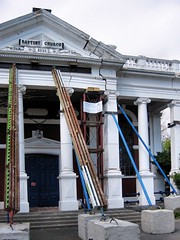
Move to Library Level 5 - Photograph 05
Images, UC QuakeStudies
A desk in the University of Canterbury's E-Learning team's new office in the James Hight building.
Earthquake damage - road
Images, eqnz.chch.2010
Aftermath of September 4th Earthquake in Canterbury (area covers Christchurch City) NZ. Storm drains - Anfield Street, Brooklands.
Resume Play: A new era for cricket in post-earthquake Christchurch
Articles, UC QuakeStudies
A PDF copy of a page on the EQ Recovery Learning site which linked to a YouTube video. In 2015, Christchurch hosted the biggest international cricket tournament ever to be played in New Zealand - the ICC Cricket World Cup. Take a look behind the scenes and through the eyes of some of Canterbury's most passionate cricketers as cricket makes its epic return to the Hagley Oval.
NZi3 - Temporary HQ - Photograph 07
Images, UC QuakeStudies
University of Canterbury library staff in their temporary office in the NZi3 building. The photographer comments, "University of Canterbury administration all fits into one building! Well, sort of. Library staff - contacting publishers to ask for free online resources. A very high hit rate, shame they're not on commission".
ELM Offices Level 7 Library - Photograph 24
Images, UC QuakeStudies
Members of the University of Canterbury's Digital Media Group in their temporary office in the NZi3 Building.
NZi3 - Temporary HQ - Photograph 22
Images, UC QuakeStudies
Members of the University of Canterbury's E-Learning team in their temporary office in the NZi3 building.
Move to Library Level 5 - Photograph 08
Images, UC QuakeStudies
Members of the University of Canterbury's E-Learning team in their new office in the James Hight building.
Move to Library Level 5 - Photograph 03
Images, UC QuakeStudies
Members of the University of Canterbury's E-Learning team in their new office in the James Hight building.
Deborah Fitchett's Dreamwidth Blog 18/3/2011: In which she turns red for C…
Articles, UC QuakeStudies
An entry from Deborah Fitchett's blog for 18 March 2011, posted to Dreamwidth. The entry is titled, "In which she turns red for Canterbury".The entry was downloaded on 17 April 2015.
Deborah Fitchett's Livejournal Blog 18/3/2011: In which she turns red for …
Articles, UC QuakeStudies
An entry from Deborah Fitchett's blog for 18 March 2011, posted to Livejournal. The entry is titled, "In which she turns red for Canterbury".The entry was downloaded on 14 April 2015.
Earthquake damage - gas station
Images, eqnz.chch.2010
Aftermath of September 4th Earthquake in Canterbury (area covers Christchurch City) NZ. Empty fuel tanks lifted out of forecourt at petrol station on Pages Road.
NZi3 - Temporary HQ - Photograph 04
Images, UC QuakeStudies
Members of the University of Canterbury's E-Learning team in their temporary office in the NZi3 building. The photographer comments, "University of Canterbury administration all fits into one building! Well, sort of. Alison McIntyre, manager of the liaison librarians, and Herbert Thomas, e-learning team leader, discussing support for teachers".
Move to Library Level 5 - Photograph 06
Images, UC QuakeStudies
A member of the University of Canterbury's E-Learning team in their new office in the James Hight building.
Observatory Tower Photograph 01
Images, UC QuakeStudies
A photograph of the Observatory tower at the Christchurch Arts Centre, taken before the 2010 and 2011 Canterbury earthquakes.
ELM Offices Level 7 Library - Photograph 25
Images, UC QuakeStudies
A member of the University of Canterbury's Digital Media Group in their temporary office in the NZi3 Building.
Move to Library Level 5 - Photograph 07
Images, UC QuakeStudies
A member of the University of Canterbury's E-Learning team in their new office in the James Hight building.
UC Restarts - Photograph 03
Images, UC QuakeStudies
A member of the University of Canterbury's Civil Defence team escorts staff to retrieve essential items from their offices.
Move to Library Level 5 - Photograph 01
Images, UC QuakeStudies
A member of the University of Canterbury's E-Learning team in their new office in the James Hight building.
Move to Library Level 5 - Photograph 09
Images, UC QuakeStudies
A member of the University of Canterbury's E-Learning team in their new office in the James Hight building.
Earthquake damage - bridge
Images, eqnz.chch.2010
Aftermath of September 4th Earthquake in Christchurch, NZ. Footbridge over Avon river
Canterbury Earthquakes Symposium - Social Recovery 101 – Waimakariri Distr…
Articles, UC QuakeStudies
Canterbury Earthquakes Symposium - Social Recovery 101 – Waimakariri District Council's social recovery framework and lessons learnt from the Greater Christchurch earthquakes This panel discussion was presented by Sandra James, Director (Connecting People) The Canterbury Earthquakes Symposium, jointly hosted by the Department of the Prime Minister and Cabinet and the Christchurch City Council, was held on 29-30 November 2018 at the University of Canterbury in Christchurch. The purpose of the event was to share lessons from the Canterbury earthquakes so that New Zealand as a whole can be better prepared in future for any similar natural disasters. Speakers and presenters included Greater Christchurch Regeneration Minister, Hon Dr Megan Woods, Christchurch Mayor, Lianne Dalziel, Ngāi Tahu chief executive, Arihia Bennett, head of the public inquiry into EQC, Dame Sylvia Cartwright, urban planner specialising in disaster recovery and castrophe risk management, Dr Laurie Johnson; Christchurch NZ chief executive and former Press editor, Joanna Norris; academic researcher and designer, Barnaby Bennett; and filmmaker, Gerard Smyth. About 300 local and national participants from the public, private, voluntary sectors and academia attended the Symposium. They represented those involved in the Canterbury recovery effort, and also leaders of organisations that may be impacted by future disasters or involved in recovery efforts. The focus of the Symposium was on ensuring that we learn from the Canterbury experience and that we can apply those learnings.
SCIRT, The Construction Industry Health and Safety Leaders - poster
Articles, UC QuakeStudies
A poster created by University of Canterbury students outlining their findings from examining SCIRT's approach to managing health and safety.
Women's place-making through craft in in post earthquake Canterbury
Research papers, University of Canterbury Library
INTRODUCTION: There is little research on the role of creative arts and craft in disaster recovery. This article reports findings about the emergent role of crafting from research conducted after the 2010–2011 series of earthquakes in Christchurch and surrounding districts in Aotearoa New Zealand. In particular, the article focuses on the significance and differing interpretations of the notion of place expressed by participants through their craftwork, in this case led by women and mediated by the post-earthquake geographic and temporal context. METHOD: This qualitative research included nine individual interviews and five focus group interviews with crafters from Christchurch and surrounding districts. There were 35 participants in total, 33 were women. Applied thematic analysis was used to code the data and identify themes. These themes included connection to place, the symbolism of craft, the healing experience of craft groups and places for women. The notion of place was evident across all three themes. FINDINGS: The findings from the research demonstrate differing ways in which the significance of place was reflected in the craftwork. Participants interpreted the concept of place in descriptive, symbolic, and therapeutic ways. IMPLICATIONS: More understanding about the way creative endeavours like crafting can be used to help ameliorate the impact of natural disasters is needed. Social work practitioners are encouraged to explore place-based wellbeing during their work with service users and to include aspects of artistry, craft and creativity.
Implications of the Canterbury earthquake sequence for Adelaide, South Aus…
Research papers, The University of Auckland Library
The city of Christchurch has experienced over 10,000 aftershocks since the 4th of September 2010 earthquake of which approximately 50 have been greater than magnitude 5. The damage caused to URM buildings in Christchurch over this sequence of earthquakes has been well documented. Due to the similarity in age and construction of URM buildings in Adelaide, South Australia and Christchurch (they are sister cities, of similar age and heritage), an investigation was conducted to learn lessons for Adelaide based on the Christchurch experience. To this end, the number of URM buildings in the central business districts of both cities, the extent of seismic strengthening that exists in both cities, and the relative earthquake hazards for both cities were considered. This paper will report on these findings and recommend strategies that the city of Adelaide could consider to significantly reduce the seismic risk posed by URM buildings in future earthquake.
ELM Offices Level 7 Library - Photograph 29
Images, UC QuakeStudies
A crack in a wall of the University of Canterbury Electronic Learning Media team's offices. The photographer comments, "Cracks in walls".
Aftermath of earthquake - shops
Images, eqnz.chch.2010
Aftermath of September 4th Earthquake in Canterbury. Shops on Colombo Street in Christchurch. The initial 7.1 quake has been followed by around 1590 aftershocks recorded to date - causing further damage to already weakened structures.
Christchurch earthquake
Images, eqnz.chch.2010
The September Canterbury earthquake. These pictures were taken of Colombo Street in Sydenham. A lot of masonry in this area has been damaged/fallen down. Note: these photos were taken on a cellphone; mind the quality.
Christchurch earthquake
Images, eqnz.chch.2010
The September Canterbury earthquake. These pictures were taken of Colombo Street in Sydenham. A lot of masonry in this area has been damaged/fallen down. Note: these photos were taken on a cellphone; mind the quality.
Christchurch earthquake
Images, eqnz.chch.2010
The September Canterbury earthquake. These pictures were taken of Colombo Street in Sydenham. A lot of masonry in this area has been damaged/fallen down. Churchill tavern. Note: these photos were taken on a cellphone; mind the quality.
Christchurch earthquake
Images, eqnz.chch.2010
The September Canterbury earthquake. These pictures were taken of Colombo Street in Sydenham. A lot of masonry in this area has been damaged/fallen down. Churchill Tavern. Note: these photos were taken on a cellphone; mind the quality.