
Aerial image of a residential area of Christchurch taken by the Royal New Zealand Air Force for the Earthquake Commission.

Aerial image of a residential area of Christchurch taken by the Royal New Zealand Air Force for the Earthquake Commission.

Aerial image of a residential area of Christchurch taken by the Royal New Zealand Air Force for the Earthquake Commission.

Aerial image of a residential area of Christchurch taken by the Royal New Zealand Air Force for the Earthquake Commission.

Aerial image of a residential area of Christchurch taken by the Royal New Zealand Air Force for the Earthquake Commission.

Aerial image of a residential area of Christchurch taken by the Royal New Zealand Air Force for the Earthquake Commission.

Aerial image of a residential area of Christchurch taken by the Royal New Zealand Air Force for the Earthquake Commission.

Aerial image of a residential area of Christchurch taken by the Royal New Zealand Air Force for the Earthquake Commission.

Aerial image of the Christ Church Cathedral in Christchurch taken by the Royal New Zealand Air Force for the Earthquake Commission.

Aerial image of Cathedral Square taken by the Royal New Zealand Air Force for the Earthquake Commission. The damaged Press Building can be seen.

Aerial image of the Christchurch central city taken by the Royal New Zealand Air Force for the Earthquake Commission. The Hotel Grand Chancellor can be seen.

Aerial image of a residential area of Christchurch taken by the Royal New Zealand Air Force for the Earthquake Commission. Porritt Park is visible on the right of the photograph.

An infographic showing the causes of the CTV building collapse.

A banner listing the 115 people who died in the CTV building collapse.

A banner listing the 18 people who died in the PGC building collapse.

The Minister of Defence, Wayne Mapp, disembarking from the HMNZS Otago. The ship travelled to Lyttelton after the 22 February 2011 earthquake to help in the relief effort.
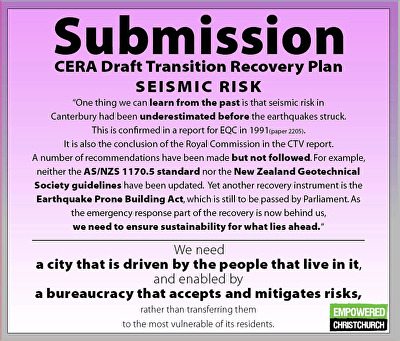
A poster created by Empowered Christchurch to advertise their submission to the CERA Draft Transition Recovery Plan on social media.The poster reads, "Submission, CERA Draft Transition Recovery Plan. Seismic Risk. One thing we can learn from the past is that seismic risk in Canterbury has been underestimated before the earthquakes struck. This is confirmed in a report for EQC in 1991 (paper 2005). It is also the conclusion of the Royal Commission in the CTV report. A number of recommendations have been made but not followed. For example, neither the AS/NZS 1170.5 standard nor the New Zealand Geotechnical Society guidelines have been updated. Yet another recovery instrument is the Earthquake Prone Building Act, which is still to be passed by Parliament. As the emergency response part of the recovery is now behind us, we need to ensure sustainability for what lies ahead. We need a city that is driven by the people that live in it, and enabled by a bureaucracy that accepts and mitigates risks, rather than transferring them to the most vulnerable residents."
