
An excavator bunching up scrap metal as part of efforts to clear the site of the demolished Hillary and Marshall Limited building on Manchester Street. A pile of scrapped wooden components can be seen at the back of the site.

A tent on Worcester Street set up for the soldiers stationed around the cordon. In the background, the damaged Our City O-Tautahi Building can be seen with steel bracing holding up the front.

A photograph of the north side of the ChristChurch Cathedral. The tower has been partially demolished leaving a large pile of rubble in front. The Citizens' War Memorial can be seen to the left.

St Mary & St Athanaslos Church on Edgeware Road. The gable at the front of the church has crumbled (as well as in the building behind). The bricks can still be seen along the ground.

A photograph of cracks in Gayhurst Road near the intersection with Glenarm Terrace. Liquefaction can be seen on the street, and there is a road cone on a crack in the footpath.

Sally Roome talking to members of the Sumner community outside the UC QuakeBox container in Sumner. Above, the damaged cliffs can be seen with a house at the edge on a lean.

An area next to the river in Kaiapoi where workers previously dug trenches to fix the power and communication lines. They have now been fixed and the trenches have been filled in. A pile of dirt can still be seen.

A photograph taken from Manchester Street of the earthquake-damaged Strange's Building. The third storeys walls have crumbled leaving the inside of the building exposed. People can be seen walking along the street after evacuating their buildings during the 22 February 2011 earthquake.
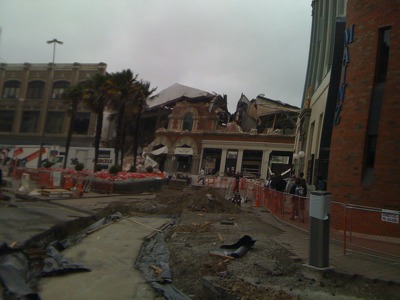
A photograph of the earthquake damage to the Domo furniture store on Tuam Street taken shortly after the 22 February 2011 earthquake. A group of people can be seen walking past the Alice in Videoland building to the right.

A photograph of a member of the public and a camera man standing in front of collapsed stores on Manchester Street taken shortly after the 22 February 2011 earthquake. An excavator can be seen in the background removing rubble.

PTE Steven Khudson on cordon duty in Christchurch central city. In the background, members of the South Australian Urban Search and Rescue team can be seen as well as a digger.

The Iconic Bar on the corner of Manchester and Gloucester Streets. The top storey of the bar has crumbled, and the bricks fallen into the street. Two crushed cars can be seen.

A photograph of buildings along Armagh Street near Victoria Square, including the Victoria Apartments and the Forsyth Barr Building. A noticable forward lean can be seen in the Victoria Apartments.

A photograph of members of the public walking along the edge of the cordon on the intersection of Colombo and Gloucester Streets. In the background, the Forsyth Barr Building can be seen as well as the partially-demolished PricewaterhouseCoopers Building.

A photograph of a rubble from the earthquake damaged Cycle Trading store on Manchester Street taken shortly after the 22 February 2011 earthquake. A cars headlights can be seen through the rubble. The store's main window has been broken and the doors left open.

A photograph of One Big Sugar Bowl on High Street. USAR codes can be seen spray-painted on the window and a window pane to the left has been boarded up with plywood. Furniture remains on the street.

A photograph of the north-west corner of the ChristChurch Cathedral in Cathedral Square. The tower to the right has been partially demolished with only the lower section remaining. The door to the tower can be seen through the broken walls.

A photograph of detail of the Cathedral of the Blessed Sacrament. The tower on the south-west corner has partly crumbled, leaving the inside space exposed. A door can be seen propped up against the interior wall.

The PricewaterhouseCoopers building photographed from Cambridge Terrace, across the Avon River. A skip can be seen on the road as well as wire fencing and a road cone. Some of the windows above are broken and have been boarded up with wood.

A photograph looking across a car park on Manchester Street to crowds at LUXCITY. Part of a large-scale hanging sculpture titled Altitude can be seen on the left.

A photograph of crowds on Manchester Street at LUXCITY. A large-scale, hanging sculpture titled Altitude can be seen on the right. In the distance is Archrobatics.

The Gap Filler headquarters on a vacant lot on Colombo Street in Sydenham. Wheelbarrows full of new plants decorate the outside area. In the background is a mural with a poem reading, "The things which I have seen I now can see no more".

A photograph looking south down Colombo Street towards the badly-damaged ChristChurch Cathedral. The bell tower has been partially demolished, and the rubble is visible in front. The Citizens' War Memorial can also be seen to the left.

A photograph of the Little India building on the corner of Gloucester Street and New Regent Street. One of the doors has been boarded up with plywood. USAR codes and a red sticker can be seen on the other.

A photograph of the front of Croydon House Bed and Breakfast Hotel, taken from behind a cordon on Armagh Street. The front windows have been boarded up and USAR codes can be seen spray painted in pink inside the porch.

PTE Steven Khudson on cordon duty in Christchurch central city. In the background, members of the South Australian Urban Search and Rescue team can be seen as well as a digger.

The corner of Manchester and Tuam Streets in town, the street cordoned off in the distance. Peaches and Cream can be seen, the walls braced with wooden planks.

Detail of the side of the front wall of St Mary & St Athanaslos church on Edgeware Road, right side. Cracks can be seen running diagonally between the bricks. The top of the wall has crumbled onto the pavement below.

Colombo Street looking south from Kilmore Street. Wire and concrete fencing has been used as a cordon. In the distance a drill and a crane can be seen, as well as the damaged tower of the Cathedral, the Forsyth Building and the BNZ Building.

A hole in the side of the road along Avonside Drive. A blue pipe can be seen inside the hole. Pipes like this were used to provide temporary water supplies to the neighbourhood while the water system was being repaired.
